The Real Way to Manage Conflicting Work
- Admin
- Sep 17, 2025
- 2 min read
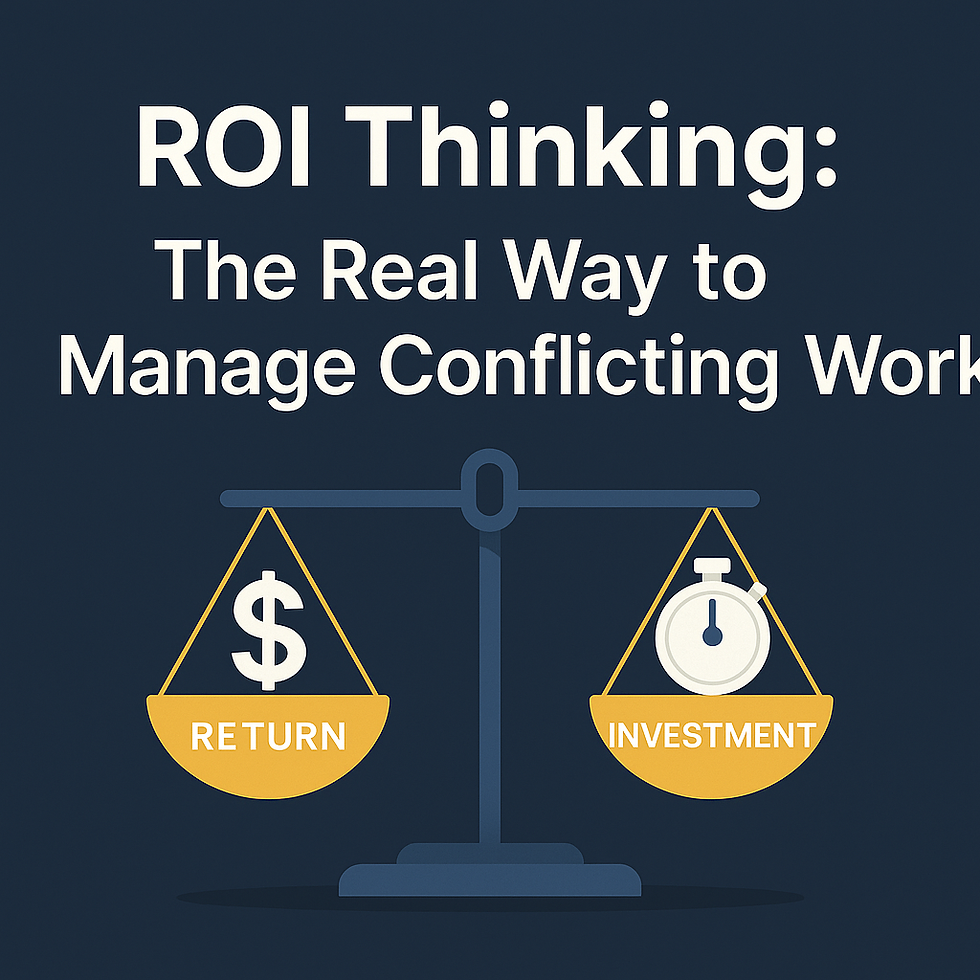
Ask anyone how they manage conflicting work and the typical answer is predictable:
“I prioritize.”
Push a little more, and they’ll say:
“Based on business priority.”
So far, so good. But here’s where most people stumble:
👉 What if the business priority is the same for both?
Some might fumble into:
“Then I’ll do the one that brings more value.”
And if you probe again?
👉 What if the value is also the same?
Now the silence grows heavier.
Because the truth is — most of us have been taught to stop questioning at “business priority.”
But leadership isn’t about swallowing priorities as given; it’s about interrogating them.
ROI as the Lens
The real compass is Return on Investment.
But ROI only makes sense if you’re clear about what goes into each side of the equation:
Investment is not just money. It’s the total cost:
⏱️ Time
👥 Resources (number of people involved)
💪 Effort and focus
💸 Actual dollars spent
Return is not always revenue. It’s the measurable outcome:
⏱️ Time saved (by automating, simplifying, removing waste)
💸 Dollar savings (reduced costs, avoided spend)
💵 Dollars earned (new revenue, upsell, expansion)
📈 Risk reduced or compliance achieved (sometimes the return is survival)
When you put these together, the logic becomes clearer. Two initiatives with the same “priority” suddenly look very different when you ask:
👉 For the units of investment, which one gives us more return?
The Hard Part: Questioning the Business
This is where it gets uncomfortable.
When the business hands you “priority A” and “priority B” as equal, it feels insubordinate to challenge.
But this is exactly where leaders distinguish themselves from managers.
Instead of asking “which should I do first?” —
ask “which gives us more return for the same investment?”
You’re not rejecting business direction. You’re refining it with sharper tools.
Why This Matters
In fast-moving organizations, everything will feel “priority 1.”
If you don’t ground your decision-making in ROI:
You burn out your teams chasing noise.
You deliver less impact while working harder.
You reinforce the illusion that “priority is decided elsewhere.”
By bringing ROI into the conversation, you elevate yourself. You’re not just executing business priorities — you’re shaping them.
The YogaForce Takeaway
Don’t stop at prioritization.
Don’t stop at business priority.
Don’t even stop at value.
Keep going until you ask:
👉 “Which work gives us the best return for the effort we’ll spend?”
That’s where clarity lives.
That’s where you stop reacting and start leading.


Comments